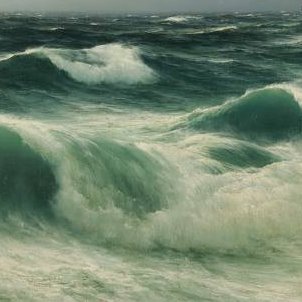
+Near+Folkestone,+12+x20+inches.bmp) John James Wilson (British, 1818-1875) Near Folkestone, 12 x 20 inches
John James Wilson (British, 1818-1875) Near Folkestone, 12 x 20 inches
Detail
Waves are usually chaotic in structure. No two are alike. To make them look convincing, brush or knife marks need to be random and varied. However, the direction of the marks should still follow the planes of the water surface, the movement of the wave, the direction of the wind, and the source of light. The white highlights on waves crests are often best done with a painting knife because knives tend to produce a more random effect than brushes. Vary not only the shape but the tone of the highlight marks. Fine marks can be made with the tip of a small knife with a relatively sharp point. Twisting the knife as you trail it lightly across the canvas creates more randomness. While striving for randomness, don't forget to make the marks decrease in size with distance. Highlights are often done in impasto, but three dimensional texture should also decrease with distance. With practice you can create the impression of fine, realistic detail with very rapid passages of knifework.

+Near+Folkestone,+12+x20+inches.bmp) John James Wilson (British, 1818-1875) Near Folkestone, 12 x 20 inches
John James Wilson (British, 1818-1875) Near Folkestone, 12 x 20 inches






 Posts
Posts