Showing posts with label Bricher. Show all posts

Friday, May 13, 2011

Tranquillity

Two Ladies in a Rowboat, 38 x 28 inches

Alfred Thomas Bircher (1837-1908) was a luminist and one of the last painters of the Hudson River School, one of the best-known schools in American art. With the advent of Modernism, the luminist style - and landscape painting in general - fell out of favor; however, in more recent times Bricher's work has seen a revival, and he is now recognised as one of the foremost marine painters of the 19th century.
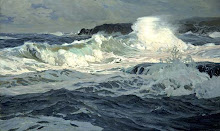
While storm-whipped waves provide a seascape with drama, the more tranquil moods of the sea give scope for the luminist exploration of light reflecting on the surface of water.
Bricher painted many of these calm, reflective coastal scenes. He often contrasts the smooth, mirror-like surface of the water with rugged cliffs and highly textured clouds. 
As a lover of maritime life and the sea he purchased a home in the 1890s close to the sea in the New Dorp section of Staten Island where he had views of the Atlantic Ocean and Raritan Bay. He lived and painted at the shore in New Dorp until his death in 1908.


detail

Tuesday, April 20, 2010

Alfred Bricher,

Looking out to Sea


Bricher's skies have a wonderful luminosity to them, and his harmonious compositions are suffused with a mood of tranquility.

Sunday, February 14, 2010

Alfred T Bricher - American

Along the Shore
12 x 25 inches


Bricher liked to use a wide format. The balancing of visual weight in left and right halves of the composition becomes more vital in wider formats. Here Bricher has used the dark shadow of the breaker, and the two boats, as a counterweight to the cliff. When painting long linear elements, such as the long waves and shoreline, its generally advisable to avoid placing them so that the lines become paths leading the viewer's eye right into a corner. Corner vectors draw the eye to the frame and out of the image. The aim of good composition is to captivate the interest of the viewer within the painting. Most artists intuitively avoid this mistake, but it's good to be consciously aware of how the linear elements in a scene can be used to act as pathways for the viewers eye between points of interest. In the Bricher's piece, a line of white breaking water links two points of interest:  the larger boat on the left and wave splashing up the cliff on the right. The two points are positioned roughly at golden mean sweet spots, which increases their visual weight.

Tuesday, January 5, 2010

Alfred Thomas Bricher - 1837-1908


Ebb Tide


The American painter Alfred Bricher was a master of balanced, tranquil compositions. Bricher is known today as the last of the important Luminist painters, a style which he likely encountered in Boston during the 1850’s. He painted the coast at different times of day and under different weather conditions. Like his contemporary, Sanford Robinson Gifford, Bricher sought to capture the sublime and spiritual in nature through his treatment of light and atmosphere. Bricher also painted in the White Mountains with Bierstadt and Champney.


Friday, May 15, 2009

Alfred Bricher - American


Rocky Head with Sailboats in Distance


Waves on a Rocky Coast, 18 x 39 inches


A Coastal Scene, 13 x 29 inches


Maine Seascape, 10 x 14 inches


Thursday, April 30, 2009

Bricher Alfred Thompson - English/American


Looking out to Sea, c. 1885, 56 x 81.3 cm
Museo Thyssen, Madrid
.
Clouds, an island and boat in the distance, act as a counter balance to the large rock.
A single figure adds a human narrative element; however, more than one figure could disrupt the mood of stillness/reverie in a piece.

Sunday, June 29, 2008

Alfred Thompson Bricher - American, 1837 - 1908


The Landing at Bailey Island, 15 x 32 inches


New England Coast - Sailboats


Castle Rock, Marblehead, 1878


Low tide, Grand Manan Island


Headlands


Rippling Sea, Manchester


Seacape with Dory and Sailboats


The Coast at Grand Manan


Whitehead, Casco Bay

A common problem with seascapes or beach scenes is lopsidedness - the structural weight of shore elements such as rocks and cliffs, is difficult to balance with water alone.

The main lesson to learn from Bricher's work is the compositional trick of using a mass of cloud, and or boat and or white foam of a breaking wave, to balance rocks/cliff on other side of painting. The boat need not be of equal size to the rocks to have equal compositional weight. This is because the comparatively blank area of the sea makes the boat stand out as a point of interest.


Sunset on Bailey Island


Sunset over the Bay


Summer Day at Grand Manan


Seascape


Seascape with Sunset


Moonrise, Coast of Maine


Grand Summer, Grand Manan


Brundith Head, Grand Manan


Morning at Saskonnet, Rhode Island


White Island Lighthouse, Isle of Shoals


Light Winds


Grand Manan


Off Grand Manan


Sailing off the Coast


Coastal Scene


Coastal Scene 2


Coastal View


Crashing Waves


Along the Coast


Baily's Island, Maine


Breaking Surf


By the Shore


See a few more at:
http://landscapesoftheself.blogspot.com/search?q=bricher