Showing posts with label Trost Richards. Show all posts

Monday, May 21, 2012

Kemper Art Museum


Childe Hassam, Diamond Cove, Isle of Shoals, 1908.
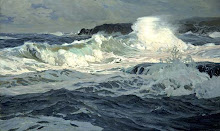
William Trost Richards, Gathering Cold, c.1885
Two marines from the collection of the Kemper Art Museum, St Louis.

Monday, February 6, 2012

From an Upcoming Christie's Sale


Edward Moran, Fishing Boat in the English Channel, 45 x 32 inches
William Trost Richards, Brigantine Shoals, 27 x 20 inches
Frederick Judd Waugh, Surf on the Roaring Main, 30 x 40 inches  


Monday, October 3, 2011

William Trost Richards

detail


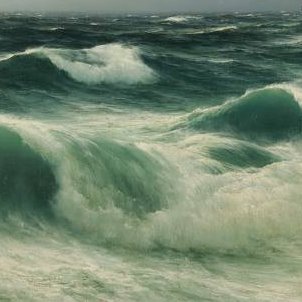
The slightly pink sky, probably of early morning, sets off the emerald hues in the waves - a  color scheme the American marine painter, Trost Richards, used many times. The sky color is brought into the troughs of the waves where they reflect it.

Wednesday, December 8, 2010

Tuesday, July 20, 2010

Fidelity & Poetry

Isle of Skye


The Cantor Arts Center at Stanford University, California, is currently presenting an exhibition of oils, watercolors and drawings by the American landscape painter William Trost Richards.
Richards was influenced by the British art theorist John Ruskin and his doctrine of truth to nature. Ruskin thought that, through close observation and accurate depiction of the natural world, artists would reveal evidence of the Creator's hand. But Richard's work is more than simply faithful to nature, it has a human poetic quality. The human artist is, afterall, a part of the natural world. To be true to nature, an artist must also be true to human nature. While depicting the outer world, an artist should also express the inner world.
Richards concentrated on seascapes in the latter part of his career, when traditional landscape painting began to fall out of favour but there was still a market for romantic images of the sea's wild, lonely, spaces. Throughout his long career he stuck to a painstaking realist style, resisting the trend toward tonalism. Though his work may be considered conservative, he is one of my favorite masters of the genre because of his ability to convey a sense of the transcendental. Since his school days, Richards had a strong  interest in literature and poetry, and this seems to have benefitted his work.

Read more at the Cantor Arts Center exhibition website.

Image courtesy Cantor Arts Center

Thursday, March 25, 2010

Subtle Tone

William Trost Richards, Great Egg Harbor Shoals 

This work conveys the impression of the soft light of morning, or evening, through the use of subtle shifts in tonal values; however, there is still suffficient tonal contrast between the darkest and the lightest part of the image to give it strength. This can be seen more easily by digitally sampling the darkest and lightest tones and comparing them. When looking at the scene on site it can be difficult for the eye to read these tonal extremes, as it tends to see the overall picture.


Sunday, December 13, 2009

Friday, December 4, 2009

Monday, November 16, 2009

Sunday, March 15, 2009

Trost Richards


This is a watercolour of the Cornwall coast.
I've included it because it's a superb composition.
The sea is framed by rocks, and the eye is led into the painting

Monday, July 28, 2008

Minneapolis Institute of Art


William Trost Richards


detail of central part


Monet


George Morland

Friday, June 20, 2008

William Trost Richards - American 1833 - 1905


The Rainbow, 1890, 40 x 72 inches


After a Stormy Day, 28 x 48 inches, c.1885


Land's End, Cornwall, 62 x 50 inches


Seascape, 18 x 32 inches


Newport Coast, 1889, 18 x 32 inches


Cornwall, 8 &3/4 x 16 inches, Oil on board, unfinished


On the Tintagel Coast, Cornwall


Breakers at Beaver Tail
(New Britain Museum of Art)


27 x 47 inches


Horsehead Rock, Conanicut Island, RI,
6 inches wide

Trost Richards was able to capture the subtle moods of nature.
The view of the Cornish Coast reminds me of the painting of the Alaskan coast by Lawrence