Showing posts with label composition. Show all posts

Wednesday, January 4, 2012

June Carey


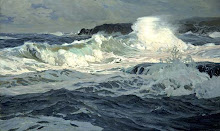
June Carey is an American land and seascape painter and wife of the late maritime artist David Thimgan (see below).
These compositions work so well because, if you divide the image in half vertically or horizontally, each half contains a balance of the two main elements - rock and water.

Sunday, October 31, 2010

The Tao of Composition

Lands End, San Francisco, 13 x 16 inches


In this piece by the American landscape painter, Raymond Dabb Yelland, the rocky foreground is roughly equal in area to the muted tones of the background sea and sky, forming a kind of Yin Yang composition. The small rock in the waves on the left helps marry the two halves. It's always good to add a little of the Yin in the Yang, and vice versa.

Friday, May 28, 2010

Atmosphere


HMS Bellona. An English man-o'-war of Nelson's Era, by Geoff Hunt. Appears on the cover of Patrick O'Brian's book "The Yellow Admiral".

There's a marvellous feeling of space in this work, by the English marine painter Geoff Hunt, due to the use of increasingly desaturated tones with distance. On the nearest ship we can see a slight obscuring of the bow in comparison with the stern.

in the work below, the more distant vessels have almost disappeared in the dense atmosphere of driving rain.

Both painters have opted for a composition based on three vessels, with the added interest of a different object - a rowboat - linked to the largest vessel. A trinity is more visually appealing than a duality. Generally, odd numbers are better than even.


Arthur Briscoe, English, 1873-1943, The White Squall, 26 x 40 inches

Wednesday, May 5, 2010

Repetition and Rhythm

Horold Harvey, 1874-1941, Waiting on the Tide
Hendrik Willem Mesdag, 1831-1915, German, Pinks in the Breakers

Both these works exploit the visually stimulating rhythms produced by the repetition of an element, in this case the masts of fishing boats. The more irregular the arrangement of the repeated elements, the more visually energetic and aesthetically satisfying. The lines vary in length, thickness, angle and spacing. By avoiding outward-leaning masts at the edges of the composition, which would tend to lead the eye out of the image, these painters prevent the visual energy from dissipating. 
These two works use a limited palette of greys enlivened here and there with a hint of red.

English painter Harold Harvey grew up in Cornwall and studied art under Norman Garstin, and then in Paris at the Académie Julian under Constant and Laurens; after his time abroad he moved back to Cornwall where he followed the style of Newlyn Artists; the artist is best known for his seaside paintings.

Thursday, April 1, 2010

Space

Fishing Boats at Sea, 50 x 60 cm
German Grobe - German 1857-1938

The shapes of the boats are interesting in themselves, but also the shape of the space between them. It's an interesting exercise to compose a painting with the spaces between objects in mind. Paying attention to the "negative space" around objects is a good way of making sure you are drawing or painting the real shapes of objects, rather than the mind's stored, habitual preconception of what a boat or a wave looks like. In the composition of paintings, spaces between objects are just as important as the shapes of the objects themselves.
In these two works, the German seascape painter German Grobe has filled the narrow space between two boats with bright foam, helping to make the negative space an element in its own right.
A common mistake is to leave to much boring empty space around the objects in a composition so that the negative spaces are lost. The work above shows a good balance between positive shapes and negative spaces. In the work below, Grobe has decided to make the space outweigh the objects, which gives a sense of the sea's power over the fishing boats. The complex textures in the waves and reflective sand make the relatively large space around the objects interesting enough to avoid the problem of lost negative space.


Tuesday, March 9, 2010

Asymmetry

Frederic Edwin Church - American, Rough Surf, Mount Desert Island


A composition consisting of  three main elements (in this case, three areas of rock), often at the vertices of an asymmetrical triangle,  is generally more pleasing to the eye than a painting where the eye bounces between just two main elements. Asymmetry is more visually dynamic than symmetry.


Frederic Edwin Church (May 4, 1826 – April 7, 1900) was an American landscape painter born in Hartford, Connecticut. He was a central figure in the Hudson River School of American landscape painters. While committed to the natural sciences, he was "always concerned with including a spiritual dimension in his works".

Saturday, February 27, 2010

Jensen M?

27 x 41 (inches?)
A horizon line located in the middle of the image, dividing it in two equal halves, can produce an uncomfortable duality, especially if it's dead straight. In this work the seabirds and white wavecrests, though insignificant in terms of the painting area, provide a unifying third element. Of course, there may be instances where a painter wants to create an unnerving, unresolved visual tension in a painting.
I posted this work because of the rich emerald and jade hues in the waves, and the fine brushwork. It came from an auction website with very little info.

Sunday, February 14, 2010

Alfred T Bricher - American

Along the Shore
12 x 25 inches


Bricher liked to use a wide format. The balancing of visual weight in left and right halves of the composition becomes more vital in wider formats. Here Bricher has used the dark shadow of the breaker, and the two boats, as a counterweight to the cliff. When painting long linear elements, such as the long waves and shoreline, its generally advisable to avoid placing them so that the lines become paths leading the viewer's eye right into a corner. Corner vectors draw the eye to the frame and out of the image. The aim of good composition is to captivate the interest of the viewer within the painting. Most artists intuitively avoid this mistake, but it's good to be consciously aware of how the linear elements in a scene can be used to act as pathways for the viewers eye between points of interest. In the Bricher's piece, a line of white breaking water links two points of interest:  the larger boat on the left and wave splashing up the cliff on the right. The two points are positioned roughly at golden mean sweet spots, which increases their visual weight.

Thursday, January 28, 2010

Edgar Payne - American 1883-1947

 Waves on the California Coast, 43 x 43 inches


Don't be afraid of trying a square format. It can be challenging compositionally but also very interesting.
Edgar Payne wrote a book titled “Composition of Outdoor Painting”.

Sunday, December 27, 2009

John Singer Sargent - American


Low Tide at Cancale Harbour


The Derelict


Sargent has found an interesting viewpoint for the top painting. The arrow shape of the harbour wall is unusually dynamic, threatening to lead the eye out of the composition, but the other objects draw it back in.

In The Derelict, the placement of the ship on the right of the image intuitively feels right. The eye of the viewer tends to read a painting from left to right. Objects on the right give a sense of the passing of time and tranquility (which suits the subject - a derelict boat) whereas a single object on the left can evoke a more abrupt or violent mood.

Tuesday, December 1, 2009

Edward Moran


Off Calais Pier


 As a general principle, diagonal lines that lean in towards the centre of the image are considered better compositionally. Outward leaning lines tend to lead the eye out of the frame of the image, lessening its visual gravity. 
The lines of the mast, horizon, boat's wake, and the edge of the sail of the rear boat, converge on a group of figures, creating a focus of interest.

Saturday, October 3, 2009

Frederick Childe Hassam - American


Isles of Shoals,
Broad Cove,
1911


In this work by the American impressionist Childe Hassam, the interlocking areas of water and land are nearly the same in size and shape, creating a sort of yin yang symbol. This produces a visual ambiguity of figure and ground - the viewer's eye cannot fully decide if the land is the figure on the ground of the sea, or vice versa. This makes the composition more interesting.
Childe Hassam was one of the handful of artists who took the Impressionist style of landscape painting from Europe to America.

Thursday, October 1, 2009

William Edward Norton - American 1843-1916


On the Coast of Holland, 42 x 34 inches

Ships' masts provide vertical elements to counter the horizontality of the sea. The vertical element provided by the fisherman is extended by his reflection in the wet sand, and provides a visual link from the bottom of the painting through the boat to the top of the composition.  I've noticed that old master seascape painters often make an opening, or lighter area, in the clouds behind the top of a mast. The light tone contrasts with the dark tone of the mast, creating a focus of interest for the viewer's eye - a kind of full stop at the end of the sentence - and also can suggest an extension of the visual path into the infinite.
The intervals between sets of elements should be varied, to create more visual interest. Avoid painting regular spacings (like the posts in a fence) or the scene will appear unnatural. This rule could be broken if the intention is to create a surreal effect.

Wednesday, August 19, 2009

Evan Wilson - American


Black Point, 24 x 18 inches

The cliff mass takes up most of the image area, so there is no need for a counterbalancing object in the sea, such as a rock or a boat. Other things used as counterbalances to cliffs are: clouds (especially heavy, dark storm clouds), human figures, a large, well defined wave, a sheet of white spray. They need not be large.

Albert Bierstadt - German American


Entrance to the Golden Gate, 16 x 22 inches


In each of these works Bierstadt has included a rock to the left of the painting, as a counterbalance to the weight of the cliff on the right.

Tuesday, August 18, 2009

Walt Kuhn - American


Ocean Cliffs, 1914, 24.75 x 29 inches
.
The cliffs are nearly far enough to the right of the composition to require some counterbalancing object on the left. This nearness to a point of imbalance gives the image a modernist edginess that works with the subject matter of stark cliffs. The light tones and colours of the cliffs, which are similar to those in the sea and sky, lessen their visual weight so that the small area of contrasting tones in the lower left corner is enough to act as a counterbalance.

Wednesday, May 13, 2009

Robert Henri - American 1865-1929


Rocks and Sea - Monhegan Island, 20 x 25 cm

In earlier posts we discussed the idea of framing the sea with rocks on either side, to avoid a lopsided composition with a vertical element on one side, and a horizontal one on the other. In this work, it appears as if the mass of rock on the right side was added later, for this reason.

Sunday, May 10, 2009

Jasper Francis Cropsey - 1823-1900


By the Sea, Lulworth

An interesting composition with just a glimpse of the open sea. Normally objects are not painted tangential to the edge of a painting, as in the upper left corner. Perhaps this Cropsey has been cropped!

Thursday, May 7, 2009

Robert Hannaford - Australian


Middle River Morning, Oil on canvas board, 56 x 76 cm

The horizon line is barely visible, suggesting a hazy atmosphere and infinite space. Rivers entering the sea give scope for interesting compositions. The river water allows the painter to place some blue on the right, to balance the sea colour on the left. Similarly, the small white building balances the white foam on the beach. Such things may seem insignificant but can make a big difference to the visual appeal of a painting.

Friday, April 17, 2009

Ralph Wilson - Australian


Heading East, 60 x 183 cm


Evening Looking East, 32 x 91 cm


Frenchmans Beach, Stradbroke Island,
90 x 61 cm

Format:
Because of it's pleasing proportions, the Golden Rectangle is a traditional format for paintings, and the ready-made canvases available in art shops are usually standard-looking rectangles. An unusual format, however, can often produce a more interesting composition, and can be worth the extra effort of a custom-made support. The horizontal nature of the sea lends itself to formats stretched horizontally. If the intention is to focus on the water as the subject of a particular work, the vertical dimension of sky may be superfluous. On the other hand, if one wants to convey the total marine environment, this can sometimes be achieved with a vertical format - a vertical slice through the panorama.