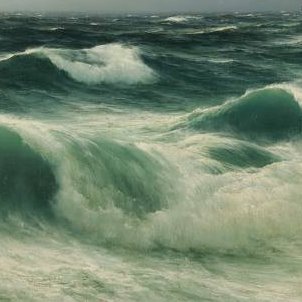
Fishing Boats at Sea, 50 x 60 cm
German Grobe - German 1857-1938
The shapes of the boats are interesting in themselves, but also the shape of the space between them. It's an interesting exercise to compose a painting with the spaces between objects in mind. Paying attention to the "negative space" around objects is a good way of making sure you are drawing or painting the real shapes of objects, rather than the mind's stored, habitual preconception of what a boat or a wave looks like. In the composition of paintings, spaces between objects are just as important as the shapes of the objects themselves.
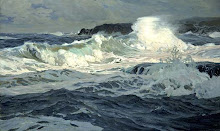
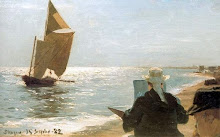
In these two works, the German seascape painter German Grobe has filled the narrow space between two boats with bright foam, helping to make the negative space an element in its own right.
A common mistake is to leave to much boring empty space around the objects in a composition so that the negative spaces are lost. The work above shows a good balance between positive shapes and negative spaces. In the work below, Grobe has decided to make the space outweigh the objects, which gives a sense of the sea's power over the fishing boats. The complex textures in the waves and reflective sand make the relatively large space around the objects interesting enough to avoid the problem of lost negative space.






 Posts