Wednesday, September 8, 2010

Sunday, August 22, 2010
Ray Roberts


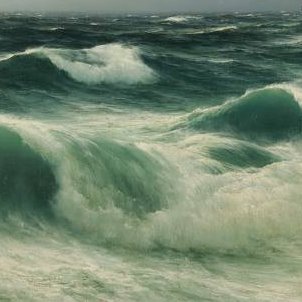
The small touches of pink in these two works, by the American painter Ray Roberts, are very important to their success.
Link to gallery here.
Thursday, August 12, 2010
John Anderson 1947-


The seascapes of Australian painter John Anderson draw in equal parts from his imagination and from his experience of the Australian coastal environment. His use of chiaroscuro contributes to the sense of images emerging from an inner dream state.
"I like to make paintings that show the puzzle of existence. Something that when people look at it they say, yes I have felt that."
- John Anderson
Thursday, August 5, 2010
Peter Graham - British 1836-1921


Sea Stack, 36 x 24 inches
Saturday, July 31, 2010
Visual Paths
 Crossing the Bar, 1922, 26 x 38 inches
The artist has used a zigzag line of foam to lead the eye through the painting.
Tuesday, July 20, 2010
Clarkson Stanfield - English

A Dutch Dogger Carrying Away her Sprit,1846
Oil paintings of seascapes and shipping in the Dutch style had been collected in Britain since the Dutch started making them in quantity. British artists also painted similar scenes to meet the demand from collectors. Clarkson Stanfield was regarded by many of his contemporaries as the best British marine oil painter of his time. His dramatic and accurate depiction of the sea in rough weather was thought preferable to Turner's misty and poetic paintings.
Here the artist shows a fishing boat in difficulties in a storm, with the power of the waves manifest against the tiny craft. The Dogger Bank in the North Sea was one of the best areas for fishing, but was prone to sudden squalls, making the life of a poor fisherman even more hard and dangerous.
Frederick Clarkson Stanfield (1793-1867) was a painter in oils and watercolours, mainly of landscapes and marine views. The son of an actor, J. F. Stanfield, he went to sea as a young boy and was press-ganged into the Royal Navy, but he left the service after being injured. He painted stage scenery for theatres in London, where he was a friend and rival to the Scottish painter, David Roberts (1796-1864) with whom he also collaborated, making dioramas and panoramas.
Source: Victoria and Albert Museum website
Clarkson Stanfield, View on the Scheldt, 1826
Fidelity & Poetry

Isle of Skye
The Cantor Arts Center at Stanford University, California, is currently presenting an exhibition of oils, watercolors and drawings by the American landscape painter William Trost Richards.
Richards was influenced by the British art theorist John Ruskin and his doctrine of truth to nature. Ruskin thought that, through close observation and accurate depiction of the natural world, artists would reveal evidence of the Creator's hand. But Richard's work is more than simply faithful to nature, it has a human poetic quality. The human artist is, afterall, a part of the natural world. To be true to nature, an artist must also be true to human nature. While depicting the outer world, an artist should also express the inner world.
Richards concentrated on seascapes in the latter part of his career, when traditional landscape painting began to fall out of favour but there was still a market for romantic images of the sea's wild, lonely, spaces. Throughout his long career he stuck to a painstaking realist style, resisting the trend toward tonalism. Though his work may be considered conservative, he is one of my favorite masters of the genre because of his ability to convey a sense of the transcendental. Since his school days, Richards had a strong interest in literature and poetry, and this seems to have benefitted his work.
Read more at the Cantor Arts Center exhibition website.
 Image courtesy Cantor Arts Center
Subscribe to:
Posts (Atom)






 Posts
Posts